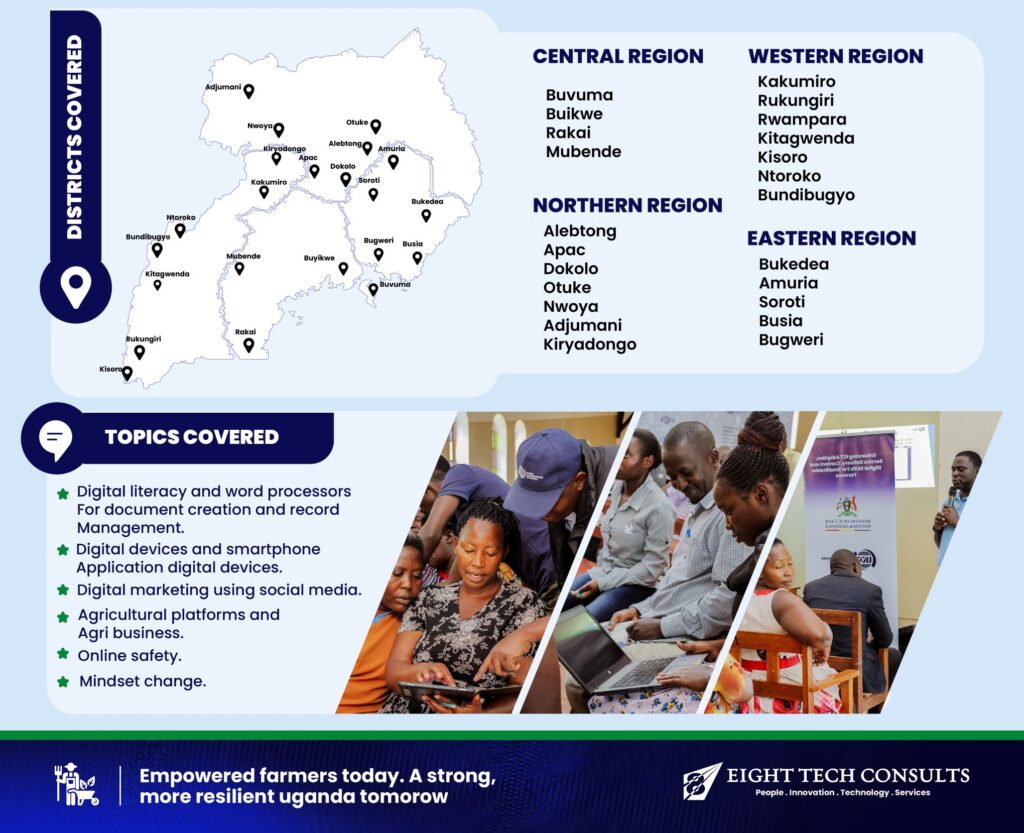

How Eight Tech Consults, supported by UCC/UCUSAF, brought hands on digital skills to smallholder farmers across the country and built a grassroots champion network to keep the momentum going.
Uganda’s agricultural sector is being reshaped by digital innovation weather alert apps, e-marketplace platforms, mobile money, digital extension services yet most of the people who stand to benefit most from these tools have never touched them. According to Uganda Bureau of Statistics data, only 25% of rural farmers have ever used a digital tool for agriculture, and fewer than 10% can access agricultural content in their own language.
The barriers are well-documented: low digital literacy, weak infrastructure, limited smartphone access, and content built for urban audiences. The tools exist. The gap is in the skills and confidence to use them.
That is precisely the gap the Digital Skilling for Farmers Programme was designed to close. Funded by the Uganda Communications Commission (UCC) through the Uganda Communications Universal Service and Access Fund (UCUSAF), and implemented by Eight Tech Consults Limited, the programme ran from February to May 2026 and the results exceeded every target set.
A Programme Built on Evidence, Not Assumptions
Before a single training session began, Eight Tech conducted a structured digital skill needs assessment across all 24 target districts surveying 477 smallholder farmers and interviewing 70 district officials, ICT officers, agricultural extension workers, and District Farmer Association (DFA) representatives. Data was captured using Kobo Toolbox on mobile devices to ensure accuracy and real-time quality control.

The assessment revealed a striking finding: 77.9% of farmers preferred a mix of theory and practical learning over classroom-only instruction. That preference directly shaped every aspect of the programme’s five-day delivery model.
The curriculum was then reviewed, updated, and localised for each region simplified for low-literacy learners, enriched with local value chain content (coffee in Rukungiri, cassava in Nwoya, dairy in Kisoro, rice in Amuria), and expanded to include real-world cybersecurity examples, mobile money fraud awareness, and digital marketing guidance for farm products.
Training delivered in five local languages:
- Luganda
- Runyankore-Rukiga
- Luo (Lango & Acholi)
- Ateso
- Lusoga
All localised content was also uploaded to the national e-Agriculture Academy at academy.unffeict4farmers.org for ongoing self-paced access.
Five Days That Changed the Way Farmers See Technology
Two parallel field teams were deployed simultaneously Team One covering twelve Northern and Eastern districts, Team Two covering twelve Eastern, Western and Central districts enabling the programme to maintain momentum and complete all 24 districts within the implementation window.
Each five-day session followed a carefully structured blended model:
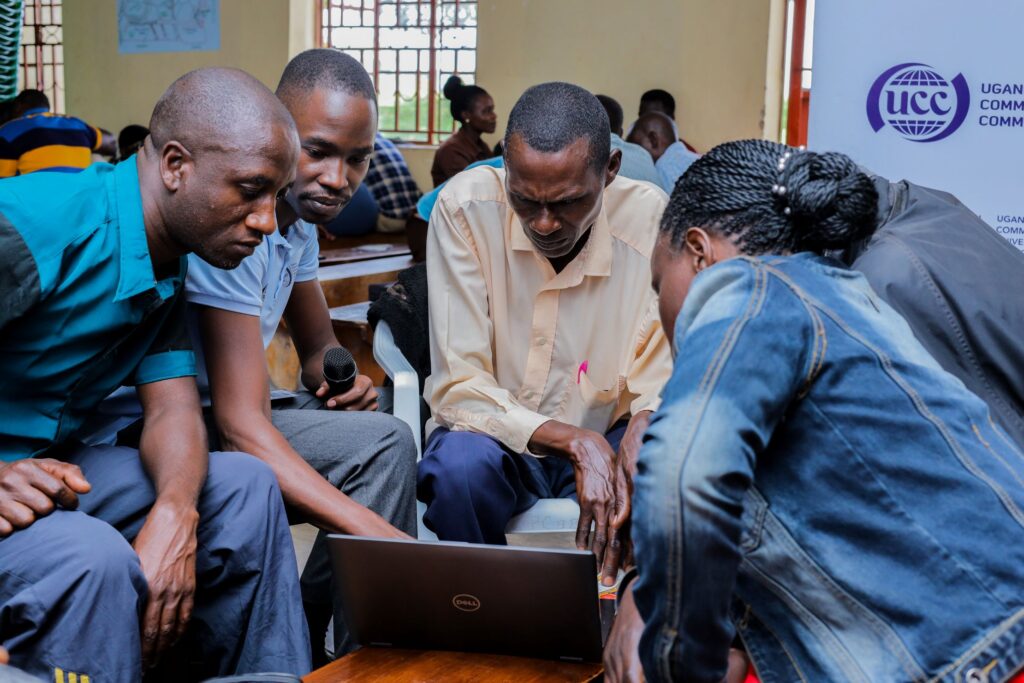
- Days 1–2: Foundational digital literacy, mindset shift, and device orientation working with laptops, tablets, and smartphones, many farmers for the first time.
- Days 2–3: Information processing, internet navigation, online safety, and e-government services including mobile money and agricultural platforms.
- Day 4: A dedicated field visit to model farms where participants observed and practised with farmers already using digital agricultural tools the highest-rated session element across all districts.
- Day 5: Reflection, consolidation, digital tool practice, and a certification ceremony presided over by senior district officials including Deputy RDCs, District Production Officers, and Sub-county Chiefs.
The Numbers: Reaching Across Uganda
Against a combined target of 2,140 farmers, the programme trained and certified 2,157 participants surpassing the target by 17. The participant profile reflected a genuine commitment to inclusion. Of 2,157 participants, 1,075 were women (49.8%) near-equal gender parity and 73 participants living with disabilities took part across the 24 districts. Youth aged 18–35 made up 979 participants, while 1,163 participants were aged 36 and above, confirming that digital skilling is not a young person’s domain only.

Building a System That Outlasts the Training
Perhaps the most strategically significant outcome of the programme is not what happened in the five-day sessions, but what was put in place to sustain it. Digital skills gained in a workshop disappear quickly without reinforcement. Eight Tech built sustainability into the programme architecture from day one.
At the conclusion of each district’s training, nine high-performing participants were identified per district as Trainers of Trainers (ToTs) grassroots Digital Champions selected based on their rapid skill gains, peer support behaviours, community embeddedness, and willingness to continue. Across all 24 districts, 216 Digital Champions were registered, each embedded in their farming community and tasked with ongoing peer learning, troubleshooting, and mobilising new cohorts.
Post-training WhatsApp farmer groups were established in every district. All participants were guided through creating accounts on the ICT4Farmers platform and the 8learning.org e-learning portal. Where connectivity was limited, offline content was distributed on USB drives and SD cards.
Because every participant was drawn from existing District Farmer Association (DFA) membership rolls, each trained farmer remains embedded in an associational structure with a chairperson who can monitor uptake, offer follow-up support, and mobilise members for future training cycles. The DFAs are not just delivery partners they are the long-term accountability infrastructure.
Mass Media: Taking the Programme Beyond the Training Venues
Training rooms reach hundreds. Radio reaches hundreds of thousands. The programme ran 19 radio sessions across both implementation phases on stations including 93.1 IUIU FM (Mbale), 90.2 Voice of Busia FM, Kakumiro Community Radio, 96.9 Rukungiri FM, Desert Stream 106FM (Amuria), and KBS FM 107.7 (Rakai), among others.
What the Programme Proved
The final evaluation data tells a clear story. Of farmers who rated the programme, 80% rated it Excellent or Good. Of 783 respondents who scored their likelihood of recommending the training to a fellow farmer, 84.9% gave a score of 8 or higher out of 10 and 56.3% gave the maximum score of 10.
The top-rated elements were practical sessions, group activities, and topic relevance. The lowest-rated element across the board? Session duration participants consistently wanted more time, particularly for advanced topics like spreadsheets, digital marketing, and e-commerce tools.
The programme also demonstrated that technology training in rural Uganda must begin with attitude before applications. Districts where the Day 1 mindset session was given adequate time reported noticeably stronger participant engagement from Day 2 onwards. The psychological and cultural dimension of digital adoption is real, and skipping it undermines everything that follows.